
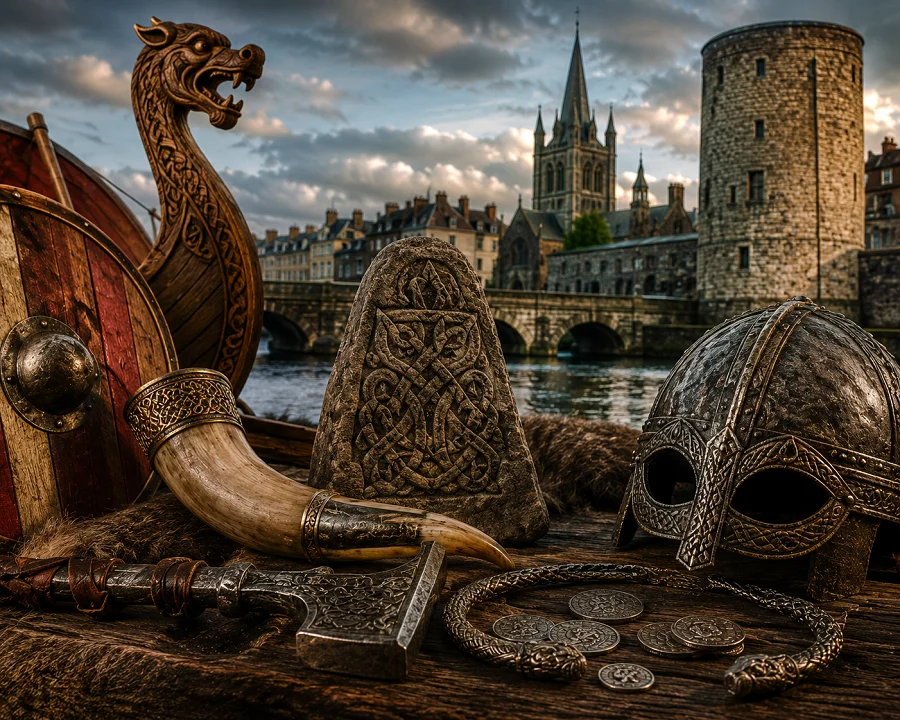

Dublin’s name carries its Viking origins whether locals think about it daily or not. The city grew from a Norse settlement founded on the banks of the Liffey in 841 AD, expanding into what became known as Early Scandinavian Dublin by 849, when Viking longships first marked their claim to the surrounding land. That founding moment is still physically remembered in the city today, and the symbolic world the Vikings brought with them, runes, protective charms and gods associated with fortune, has travelled a surprisingly long way, turning up now in the visual language of modern casino slot games. This article traces that history and explains how Norse luck symbolism found its second life on the reels.
The Steine: Dublin’s original Viking marker
Long before Dublin had a coat of arms or a cathedral, it had a stone. The Steine of Dublin was a Viking standing stone, or steinn in Old Norse, erected to mark the exact spot where Viking longships landed and docked in the city, signifying their ownership of the surrounding lands. Built shortly after the Vikings founded their Dublin settlement in 849 AD, the stone gave its name to the whole surrounding area and even to a local river and pub that still carry echoes of that Norse naming today. It stands as one of the clearest physical reminders that Dublin’s earliest identity was written in a Scandinavian hand.
Runes: the Viking alphabet of secrets and fortune
The runic alphabet was far more than a writing system to the Vikings who founded Dublin. The word rune itself comes from the Old Norse term for a secret or a mystery, and beyond recording names and simple messages, individual runes carried standalone symbolic meaning tied to protection, luck and balance. This was not confined to Scandinavia itself. Archaeologists have found genuine Viking-era runic inscriptions in Ireland, including objects unearthed during excavations of Viking houses and settlements, with one particularly notable find, a bone comb bearing a runic inscription, discovered on Fishamble Street in Dublin, right in the heart of the old Viking settlement.
The rune Fehu, representing cattle and wealth, is specifically associated with luck, abundance and prosperity in Norse tradition, embodying the fulfilment of ambitions and the arrival of well-deserved reward. This direct, literal association between a specific symbol and material fortune is precisely the kind of imagery that translates effortlessly onto a slot machine reel, where symbols exist for exactly this purpose: to represent the arrival of reward in visual shorthand.
Vegvísir: the wayfinder that never lets you get lost
Among the most recognisable Norse protective symbols is the Vegvísir, an eight-branched compass-like stave whose name translates roughly as wayfinder. Vikings inscribed it on their ships specifically to ensure they could always find their way home, and it was also worn as a personal talisman believed to bring luck and protection to its bearer. For a seafaring culture whose entire settlement of Dublin depended on successfully navigating open water, a symbol promising safe return carried enormous practical as well as spiritual weight.
The Vegvísir’s popularity as a modern tattoo and jewellery design reflects how well this specific promise, guidance through uncertainty toward a good outcome, still resonates today. That same promise is essentially what a casino game offers on a smaller, more playful scale: a symbol suggesting that the spin in front of you, however uncertain, is heading somewhere favourable.
Mjölnir: Thor’s hammer as the ultimate luck charm
Few Norse symbols carry as much instantly recognisable power as Mjölnir, the hammer of Thor. Associated with the protector god of thunder and war, Mjölnir amulets represented strength, bravery, good luck and protection from harm, and archaeological evidence shows they were worn widely across the Viking world, including in Norse settlements throughout Ireland and Britain. Thor himself was closely tied to another ancient luck symbol still recognised today: the swastika, which in Norse religious tradition was linked directly to Thor and was engraved on objects specifically to bring luck and sanctity to their owners, a meaning entirely distinct from its horrific twentieth-century appropriation.
Mjölnir’s continued cultural weight, still worn as jewellery and tattooed as a symbol of strength today, explains why hammer and thunder imagery appears so frequently in Norse-themed casino games. It is a symbol whose meaning, power arriving suddenly and decisively, maps almost perfectly onto the moment a big win lands on the reels.
The Triquetra: where Celtic and Norse fortune overlap
Dublin’s story is not purely Viking. The city’s Norse settlers arrived into and gradually blended with an existing Celtic culture, and nowhere is that blending clearer than in the Triquetra, or Trinity Knot, a symbol of three interlocking triangles forming one continuous, unbroken line representing eternal life with no beginning or end. Although the Triquetra originated as a Celtic rather than Norse design, increased contact and intermarriage between Vikings and the peoples of Ireland and Scotland saw the symbol absorbed into shared Norse-Celtic visual culture, a genuine product of Dublin’s own mixed Viking-Irish heritage.
The Norns and the Wyrd: fate itself as a woven symbol
Perhaps the deepest layer of Norse luck symbolism concerns fate itself. According to Norse mythology, three beings called the Norns lived beneath the world tree Yggdrasil, guarding the Well of Urd, the source of fate, where they wove the tapestry that determined the destiny of every living being. The Wyrd Web, a symbol of nine intersecting lines containing every rune within it, represents this woven fate directly, and tradition held that gazing upon it could reveal glimpses of past, present and future alike.
This idea, that fortune is something woven in advance rather than purely random, gives Norse mythology a genuinely distinctive relationship with luck compared to many other folklore traditions, one that modern NYE Dublin celebrations and their fascination with fresh starts and fortune for the year ahead echo in their own smaller way, even if most revellers making resolutions have no idea they are drawing on a thousand-year-old Norse concept of woven destiny.
From longship to slot reel: why Norse symbols work so well in games
Game designers have found Norse mythology to be an unusually rich source of slot imagery, and the reasons go beyond aesthetics. Viking symbols already carry centuries of accumulated meaning around luck, protection and fortune, meaning a designer does not need to invent symbolism from scratch the way an entirely original theme would require. Runes, Mjölnir, longships and gods like Thor and Odin arrive already loaded with the emotional weight of fortune and destiny, which is precisely what a slot symbol needs to communicate instantly without any explanation.
A well-designed Norse-themed casino experience, such as the one found through lucky wands casino, draws directly on this deep well of symbolism, using runic imagery and mythological figures to create a sense of ancient, weighty fortune rather than a purely modern, invented aesthetic. Recognising the genuine history behind Fehu or Mjölnir adds a layer of appreciation that a player unfamiliar with Norse mythology simply would not have.
Symbolism as culture, not as genuine influence over outcomes
It is worth being clear about what this rich history does and does not mean for actual play. These symbols carry genuine cultural and historical weight, and Dublin’s own Viking founding gives Irish players a particularly direct connection to that heritage. None of it, however, has any bearing on the outcome of a modern casino game, which is governed entirely by certified random number generators regardless of how many runes or hammers appear on the reels. The value here is cultural appreciation, not a belief that ancient symbolism changes actual odds.
Responsible enjoyment of Norse-themed games
Games built around this kind of rich mythological symbolism can be genuinely enjoyable precisely because of the history behind the imagery, but the same sensible limits that apply to any casino gaming remain just as relevant here. Set a clear budget and time limit before you start playing, and treat the experience as entertainment grounded in genuine historical interest rather than an expectation of the fortune the symbolism describes. If gaming ever starts to feel difficult to control, free and confidential support is available. Gamblers Anonymous Ireland holds regular meetings across the country and welcomes anyone with questions about their own play.
Conclusion
Dublin’s Viking founding left the city with far more than a name and a standing stone by the Liffey. The runic alphabet, protective charms like the Vegvísir and Mjölnir, and the Norse concept of woven fate all form part of a rich symbolic inheritance that has quietly resurfaced in the design of modern casino games, centuries after the last longship docked at the Steine. Understanding this genuine history transforms these symbols from decorative shorthand into something with real cultural depth, whether encountered in an archaeological display or on the reels of a game built on a thousand years of Norse storytelling.